Stones, Not Bricks
Retired university professor Shuaib Meacham has spent three decades prying open spaces—public schools, hip-hop studios, penitentiary classrooms—where uniform “brick-making” systems once crushed human difference. It rewarded conformity while punishing creativity. uniform blocks stacked for efficiency, not freedom.
“God never asked for bricks—He asked for stones, all natural, all different. Schools are in the brick-building business.”
His solution was to meet students where their passions already burned: Hip Hop Literacy, an after-school studio where middle schoolers took their verses from Waterloo to world stages. The work kept his own spirit intact: “Hip hop was for my sanity” when top-down curricula squeezed out joy.
When the system’s tension became “unsustainable,” Meacham retired—only to start again behind the walls of Anamosa State Penitentiary. There, he teaches a 12-week “Freedom” curriculum and calls the incarcerated men “as focused and brilliant as any doctoral students I ever had.” In worship services that echo down cellblocks, he hears justice “sound like radical worship,” a space where condemned voices sing about freedom and unconditional love rewrites identity.
Across classrooms and prison yards, Meacham’s ethic stays the same: treat every learner as a God-made stone—unique, jagged, essential—never a mass-produced brick. That stance reframes ethical intelligence for the future: tap youth and “rejected” adults alike as co-architects of community wisdom.
His life’s through-line offers a blueprint: an ethically intelligent society is built from irregular stones—students, rappers, gardeners in prison—fitted together by hope rather than fear.
This is Dr. Shuaib Meacham’s Moment of Truth.
1 | What do you know from your experience that the future shouldn’t forget?
“We really have to tap into the brilliance of young people.” Meacham calls youth a “lost resource” buried under curricula that reward sameness. Hip-hop Literacy—begun “for my sanity” when top-down classrooms suffocated him—let students write.
2 | What have you protected that an algorithm would struggle to capture?
“The power of passions we have as individuals… algorithms try to routinize and normalize them.”
Meacham safeguards the “unacceptable footnote” each life carries—the messy, improvisational piece no system can code. When schools reward whatever the algorithm likes, “young people change themselves to fit what’s being rewarded”.
Healthy systems keep local genius improvising. It treats identity as a jazz solo, not a MIDI file—protecting dissonance so innovation can riff.
3 | If someone 100 years from now listened to this story, what part would still be true?
“The priority of people’s passions and personal visions—humans will always have those idiosyncrasies that make life powerful when we embrace them instead of control them.”
Stone logic again: systems that try to enslave difference will always crack; societies that honor it will keep evolving.
4 | What kind of intelligence deserves your trust?
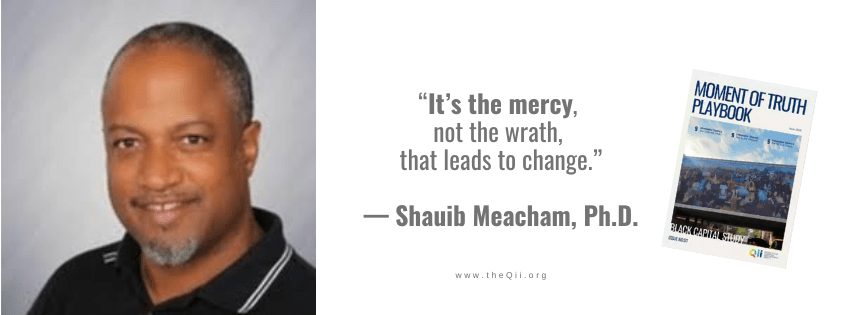
“From my own life experience, I trust divine intelligence. It’s the mercy, not the wrath, that leads to change.”
He recounts men in the Anamosa State Penitentiary who “literally became different people because of the love they experienced”—one baptized weeks after deciding “I’ll do things God’s way now”.
The healthy systems he might sign off on must center radical acceptance and transformational hope, not predictive punishment.
5 | What does justice sound like—in your voice?
“Justice sounds like worship. It’s a radical letting-go that invites the Holy Spirit to prevail.”
On Easter weekend inside the prison, taped services included live worship. A volunteer who attended both campus services said there was “no comparison to the power of music:
“In a room of incarcerated people singing about freedom, justice actually manifests in that moment.”
Communal singing reframes condemned identities into co-creators of hope; it’s restorative justice in surround-sound.
© 2025 Institute for Quantum Innovation & Impact (The Qii). Licensed under CC BY-NC-ND 4.0.
Originally catalyzed by philanthropic seed funding and now stewarded by the innovators whose stories appear here, with support from a growing network of researchers, educators, system architects, and community investors.

