When Dreams Rewrite Laws
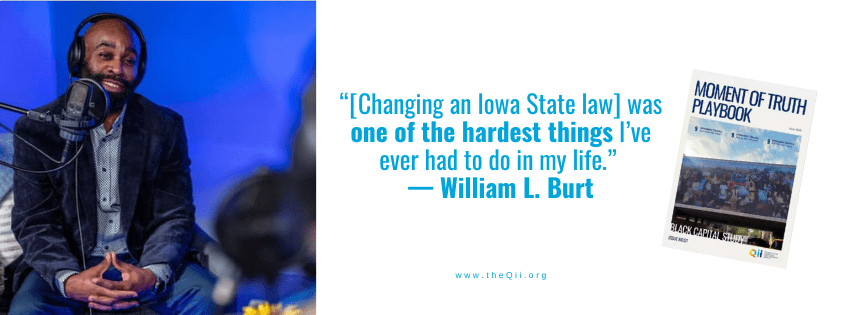
When most people dream, they wake up and move on. But when this barber from Waterloo had a dream, he built it—literally. In that vision was Kut Kings Mobile Barbershop, a fully mobile barbershop designed to serve the sick, the shut-in, the single mom with four boys, and veterans who couldn’t travel far. He didn’t just imagine it—he drove to Indiana, bought the vehicle, and began the buildout.
Then came the barrier: his dream wasn’t legal in Iowa.
The law required four walls and a foundation—his wheels made it “invalid.” Instead of giving up, he launched a grassroots movement, rewrote legislation, and created a new category of barbershop altogether. It took 2.5 years, all his savings, and a stubborn refusal to quit.
This is William L. Burt’s Moment of Truth.
1 | What moment changed everything for you?
“I would come to work every day feeling claustrophobic, feeling like I had hit my ceiling at Gray’s. I wanted more. I felt there was more out there for me in the world to accomplish.”
For almost a decade, he worked at Gray’s Barbershop. His coworkers were content, but he wasn’t.
Then one night, he sat up from sleep. The whole idea came to him in a dream: a mobile barbershop—called Kut Kings Mobile Barbershop.
“It may sound fabricated, but everything came to me in this dream… the name, the vision, the purpose. That told me: yes, this is the one that’s made for me.”
From that moment, he dove in: researching, Googling, learning about wheelchair accessibility, and adapting models he saw online. His clients weren’t just anyone—they were single moms, veterans, and the sick and shut-in. He needed a lift. He found a vehicle. He hit the road to Indiana and brought the dream home.
2 | What system or obstacle were you up against?
He faced two major barriers: finance and the law.
First: The Money.
He tried a personal loan, but once the VIN revealed it was a commercial vehicle, the bank pulled back. “So now I need to send you to the commercial loan person. And they were completely like: No.”
He drained his own savings to make the purchase and do the buildout.
Then: The Law.
He applied for a license. Rejected. Why?
“Because the law in Iowa defined a barbershop as a four-wall structure that was immovable.”
It wasn’t malicious. It was outdated. But the result was the same: his dream was illegal.
“So that was the big obstacle: getting to the point where now it’s time to work… and I’m being told no. Because there’s a law.”
3 | What did you try, even if it wasn’t perfect?
“I put together a petition. Within a couple days, I had 1,000 signatures.”
Then he produced a 59-second video with filmmaker Nia Wilder. It got 40,000–50,000 views. The pressure rose. That’s when Tyler Raygor from Americans for Prosperity called.
“He said, ‘You’ve got a social justice issue. We want to help guys like you get past these issues.’ And I told him—if you can help me get this done, then yes.”
A two-and-a-half-year grassroots legislative campaign began.
4 | What helped you keep going?
“It was a vendetta… that lit the fuel.”
“This was the first real legit idea I had.”
He shares, with quiet courage, that he had a criminal background and once sold drugs. This vision—this mobile barbershop built for dignity—was his real shot.
“I felt like I was being told no again. Even by the system. And I wasn’t having it. If I had to stand up against the law, then that’s what I had to do.”
It drained him financially. It broke him emotionally. But it didn’t stop him.
“It was one of the hardest things I’ve ever had to do in my life.”
5 | What truth do you want people to remember from this story?
“If you know you have a vision or an idea of value, go for it. And don’t let nothing stand in the way of it.”
This was never just about him. It was about the clients waiting three to four hours, the veterans, the wheelchair-bound elders who asked, “Do you make house calls?” He wanted to answer yes.
“One thing’s for sure: if it’s worthwhile… it will see itself to an end.”
© 2025 Institute for Quantum Innovation & Impact (The Qii). Licensed under CC BY-NC-ND 4.0.
Originally catalyzed by philanthropic seed funding and now stewarded by the innovators whose stories appear here, with support from a growing network of researchers, educators, system architects, and community investors.

