Most of what exists is invisible to us. We see light between 430–790 THz, hear sound between 20 Hz–20 kHz. Add selective attention and the narrow slice of history we can absorb, and even our boldest claims about “knowing” shrink to humility. What we do know is this: survival in the unknown depends on how well we preserve what’s worth carrying forward.
A Fresh Take on Methodology
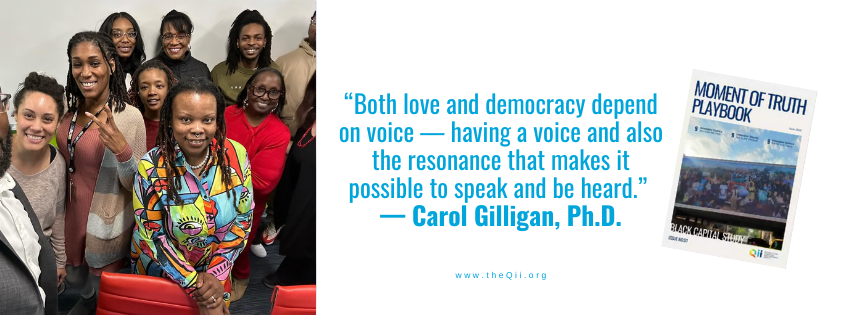
In Summer 2020, in the shadow of a pandemic, three Co-Principal Investigators joined forces around an important question—one that echoed Carol Gilligan’s (1982) decision to let girls tell their own story of growing up: “What if we center on letting underrepresented entrepreneurs tell the story of innovation in their own voices?”
What we heard changed everything. Not just about entrepreneurship, but about how knowledge gets created, whose voice counts as expertise, and what becomes possible when we change channel on systems claiming to speak for the people who navigate them daily.
Like Gilligan’s girls who learned to say “I don’t know” when they meant “I do know—but I’m not supposed to,” entrepreneurs in communities facing systemic barriers had been trained to let others interpret their success, analyze their challenges, and prescribe their solutions. Traditional research extracted their data, filtered their insights through academic frameworks, and reduced their complex navigation strategies to “lite quotes” supporting predetermined conclusions.
We chose a different path: authentic voice as infrastructure for systemic change.
The Architecture of Authentic Capital
Over five years, an evolving circle of collaborators, co-conspirators, and champions began a deliberate construction project—to understand and build economic survivability in the Waterloo, Iowa Metropolitan Statistical Area, identified in 2018 by 24/7 Wall Street as the worst place in America for Black Americans across eight quantifiable indexes. Not as charity, but as infrastructure: systems designed to multiply opportunity for innovators, entrepreneurs, and business owners who had been structurally undercut for decades.
The entrepreneurs who shared their stories revealed a capital conversion framework that expands far beyond traditional economic models:
The Capital Conversions Framework (CCF)
Working within and beyond Pierre Bourdieu’s 1986 capital conversion theory framework¹, our entrepreneurs identified nine forms of capital they strategically convert to survive and thrive:
Traditional Bourdieu Capitals (Expected):
- Financial Capital – Money, investment, revenue
- Social Capital – Networks, relationships, connections
- Cultural Capital – Education, credentials, cultural knowledge
New, less visible Capitals (Opening new doors):
4. Physical Health Capital – Energy, stamina, embodied resilience
5. Emotional Capital – Psychological resilience, emotional intelligence, healing capacity
6. Spiritual Capital – Purpose, meaning-making, transcendent connection
7. Symbolic Capital – Reputation, recognition, credibility
8. Intelligence Capital – Pattern recognition, strategic thinking, systems analysis
9. Collective Intelligence Capital – Community wisdom, collaborative problem-solving, 10x purposeful pattern advancement
Voice as Methodology, Voice as Infrastructure
Out of the 100+ Entrepreneurs that made up the backbone of the border economic development Black Capital Study, a couple of dozen diverse types of innovators with ties in or from the Waterloo, Iowa area took the mic into their own hands. Each entrepreneur didn’t just share their story, they analyzed their own capital conversion strategies, named their own innovations, and identified systemic barriers from their position of lived expertise. They became co-researchers and co-authors, not subjects. They generated insights that no external framework could have captured.
This methodological shift revealed:
- System knowledge that academic theories missed
- Innovation strategies traditional business research that often slips through the cracks
- Capital conversion techniques that challenge economic assumptions
- Survival intelligence that redefines entrepreneurial success
The Political Stakes of Authentic Voice
But architecture is political. We saw what happens when power on paper promises equity while power in practice erases contributions, blocks progress, and reroutes resources and information away from those outside the in-group. These choices were not abstract. They were made by individuals, loyal to institutions that trained them to believe such moves were ethical—that containment was better than consent, that flattening served stability, that destruction could masquerade as “efficiency.”
The math was clear—targeting the widest gap would yield the greatest impact if the surrounding architecture allowed it to stand. Over the five-year period, the Black Capital Study succeeded in several ways:
- Co-Founded an Entrepreneurial Accelerator and developed a curriculum, achieving 98% completion rate, 96% retention rate, and 100% ventures experiencing revenue growth during COVID.
- A multi-sided pipeline multiplied learning for innovators. Entrepreneurs mentored university students, helping them build a portfolio of market-ready evidence. In return, students provided reverse mentorship and manpower, tackling practicum challenges during the ventures’ periods of growth. This also allowed for testing university course principles against real-world market constraints during a global crisis, providing a better understanding of the curriculum gaps and the entrepreneurial ecosystem.
- Facilitated more than $6.5M in aggregate capital and public funding awards
- Received 23 national awards recognizing pedagogical innovation and effectiveness of this voice-centered methodology.
But systems invested in their own narratives cannot tolerate voice that reveals their contradictions.
The Constraints and the Response
Over the months leading up to May 27, 2025, Iowa’s legislature codified House File 856: public servants—including city employees, university staff, and elected officials—may no longer consider the needs of specific underrepresented or underestimated community members in their official roles.
This legislation represents the same dynamic Gilligan identified: “You’re not supposed to know what you clearly know. You’re not supposed to say what you’ve experienced. Your voice doesn’t count as legitimate knowledge.”
For our state, this is a narrowing of the commons. For those committed to ethical intelligence, it is a call to act from positions that are still free to move: as private citizens, as religious and nonprofit organizations not bound by state or local funding, and as for-profits able to withstand political penalty.
The Preservation Framework
The 27 stories in our Moment of Truth Playbook represent more than research findings, they are methodological infrastructure. They demonstrate that:
- Handing over the mic creates knowledge that external analysis cannot capture
- Voice-centered research reveals capital conversion strategies invisible to traditional frameworks
- Authentic agency in storytelling becomes economic infrastructure building
- The method IS the message about who gets to be an expert on their own experience
Legacy as Living Method
Names signed to the Black Capital Study’s Moment of Truth Playbook do not constitute rejection of excellence in any other group. It is a recognition that studying innovators who walked a different path—sometimes with justice on their side, often without it—teaches us how to strengthen the systems we all depend on.
More fundamentally, it is a commitment to methodological recalibration: to research that dignifies the voice of lived human experience, that builds capacity rather than extracting insights, and creates knowledge from well-informed impressions that depends on collaboration rather than interpretation.
The patterns we have traced are not just about the past five years; they are a replicable methodology for becoming better stewards of human and collective intelligence in whatever future we build or code next.
Even if we are blocked from continuing this work in its current form, these 27 stories speaking their truth about nine forms of capital conversion remain as infrastructure—transferable, preservable, and beneficial to at least one trust-tier beyond ourselves.
This is the Black Capital Study’s Moment of Truth: that authentic voice, when systematically centered, becomes revolutionary methodology that outlasts institutional constraint.
🗝️ Qii Questions for the Future
1 | What do you know from your experience that the future shouldn’t forget?
That power without accountability corrodes the commons, but trust, when stewarded with clarity, consent, and courage, multiplies capital in at least nine different forms. That authentic voice, when systematically centered, creates knowledge that traditional frameworks struggle to capture with standardized questionnaires and structured interviews. Equity is not charity; it is infrastructure. Methodology is not neutral; it is political.
2 | What have you protected that an algorithm would struggle to describe right?
The felt truth of human resolve when the numbers say “quit.” The meaning carried in a glance between collaborators who’ve risked something real. The sacred weight of a promise kept when no one is watching. The difference between being researched and being heard. The power of holding the mic instead of being quoted.
3 | If someone 100 years from now listened to this story, what part would still be true?
That justice is not a trend—it is the unbroken thread between the dignity we fight for today and the world we leave behind. That voice-centered methodology creates more accurate knowledge than extraction-based research. That those closest to systemic barriers often have the clearest vision for systemic solutions.
4 | What kind of intelligence deserves our trust?
One that is willing to name the fracture, hold it in the light, and resist smoothing it over for comfort. Intelligence that can change its mind without losing its integrity. Intelligence that emerges from collaboration rather than interpretation. Intelligence that trusts lived experience as legitimate expertise.
5 | What does justice sound like—in our voice?
It sounds like the steadiness of naming what is true without asking permission. It sounds like the chorus that rises when those silenced find each other. It sounds like a prayer that moves the body to act, even when it shakes. It sounds like entrepreneurs analyzing their own success strategies in their own words. It sounds like methodology becoming movement.
The complete Moment of Truth Playbook, featuring all 27 entrepreneur stories and the nine examples of the Capital Conversion Framework, is available as preservation-ready infrastructure for future voice-centered research and economic development work.
Footnotes:
¹ Bourdieu, P. (1986). The forms of capital. In J. Richardson (Ed.), Handbook of Theory and Research for the Sociology of Education (pp. 241-258). Greenwood.
² Gilligan, C. (1982). In a Different Voice: Psychological Theory and Women’s Development. Harvard University Press.
© 2025 Institute for Quantum Innovation & Impact (The Qii). Licensed under CC BY-NC-ND 4.0.
Originally catalyzed by philanthropic seed funding and now stewarded by the innovators whose stories appear here, with support from a growing network of researchers, educators, system architects, and community investors.

