A retired educator and interfaith community leader, founded the Hidden Heritage Museum on sacred virtual soil. Since 2005, he has hauled exhibits, films, and workshops across Iowa to surface “the forgotten, lost, stolen, or ignored contributions of the racially minoritized”. The work is spiritual capital in action: investing moral imagination so communities can heal racial fractures.
The Hidden Heritage Museum didn’t emerge from institutional planning. It grew from a promise made in public, during a racial justice workshop, to do something the system never expected: remember on purpose.
Built not for funding but for freedom, the museum travels—carrying with it the weight of wars fought, songs remembered, and names history textbooks never learned. Its founder didn’t wait for permission. They picked up the torch from generations past and built something to make sure they aren’t erased.
This isn’t about nostalgia. This is about staying connected to humanity in a system designed to marginalize and forget.
This is The Hidden Heritage Museum’s Moment of Truth.
1 | What do you know from your experience that the future shouldn’t forget?
“There will always be some minoritized category a healthy society has to reckon with. Race was designed over 500 years ago to give one group wealth, power, and prestige over everyone else. But people don’t fit neatly in those stratified boxes; race is always changing.”
Census boxes and school forms shape who receives resources; when census boxes ossify, school funding and health research misfire; flexible categories keep systems honest.
That’s not theory. That’s lived analysis.
The founder of Hidden Heritage didn’t need academic approval or nonprofit tax status to call it out. What they knew—what they still know—is that race is an _operating system_, not just a label. And if we forget that, it keeps running in the background.
So they didn’t build a museum to explain that to the public. They built a mobile structure that remembers—through artifacts, military histories, sports timelines, and community prayers.
2 | What have you protected that an algorithm would struggle to capture?
Hidden Heritage Museum started with a promise to protect the artifacts without a KPI-score: gospel hymns, unfinished testimonies, sundown-town maps, unlabeled photos of Black soldiers, stories of war veterans whose names never made it to the textbooks.
“Across history, we keep changing the frame of what ‘majority’ means. I’m searching for a way to turn the lens around and ask, ‘What has whiteness done to white people?”
3 | If someone 100 years from now listened to this story, what part would still be true?
“We don’t know where the gap will be, but in 100 years, there will still be a gap.
History shows cycles: there were huge Black literacy gains after the Civil War, then Jim Crow backlash.”
Wise policy plans for recurring inequity waves and build feedback loops to shorten each backlash.
Hidden Heritage Museum is about preserving truth before it disappears entirely.
The exhibits might age.
The language might evolve.
But the message will hold:
“We must restructure how race functions so that it benefits all, not just one group.”
That’s a truth meant for the long haul.
4 | What kind of intelligence deserves your trust?
Cautiously, they recommend at least a two-part filter:
“The scholar in me says citing sources and artifacts is a given if we are we are looking for trust, but there is also a second part connected to relational credibility—does it build community, rather than just extract from it?”
Wisdom isn’t a degree. It’s honest reflection.
“Trust grows when people are humane and sincere… genuinely liking other people.”
Courts, clinics, and classrooms thrive when relational credibility outranks paper prestige.
This founder also didn’t trust institutional memory. They built around it.
“Mainstream narratives have never been enough. They tell part of the story—but it’s always the part that preserves the status quo.”
They trust the kind of intelligence that listens when someone says:
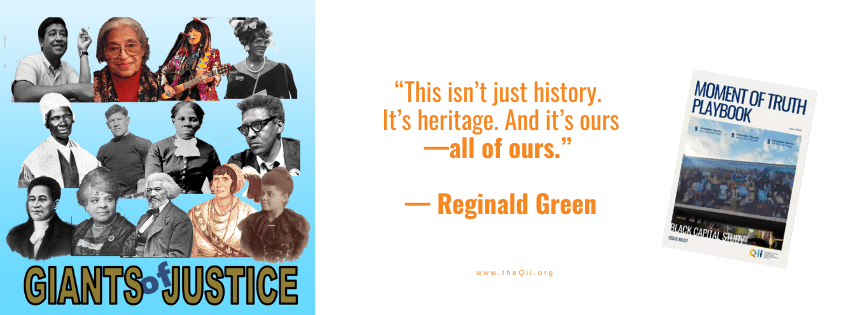
“This isn’t just history. It’s heritage. And it’s ours—all of ours.”
5 | What does justice sound like—in your voice?
“Act justly, love mercy, walk humbly with your God. — Micah 6:8”
Healthy systems leave space for that moral oxygen—ritual, song, scripture—alongside metrics.
It’s the kind of voice that still believes in prayer—not as a performance, but as a commitment to show up, even when no one’s watching.
a traveling exhibit with no budget,
a truth that moves, even when exhausted.
“We are not the exception. We are the memory.”
© 2025 Institute for Quantum Innovation & Impact (The Qii). Licensed under CC BY-NC-ND 4.0.
Originally catalyzed by philanthropic seed funding and now stewarded by the innovators whose stories appear here, with support from a growing network of researchers, educators, system architects, and community investors.

